


Korean Cladding Wellmark, naturally created green material, material produced from the successful application of Korean charcoal board research
Quoted from: KFS Journal, Vol. 21(3), 2010: 237-247
Project: Properties of charcoal panels produced from household wood waste
Project leader: In Su Seo , Hwa Hyoung Lee
BSUMMARY
This research was conducted to investigate the properties of carbon black boards, in order to find suitable production conditions for black carbon boards made from charcoal. The charcoal (carbon material) in this study was distilled from household wood waste, and the purpose of this study was also to see whether the black charcoal board has the beneficial properties of charcoal as a healthy building material against the problem of sick houses.
Domestic waste wood includes 40% MDF, 30% PB, 15% plywood and 15% wood, respectively. Carbon black panels are produced by hot pressing method with the following conditions; temperature 170℃, three-stage pressing cycle 40-10-40 kgf/㎠(1 min-2.5 min-5 min) and formaldehyde-free adhesive
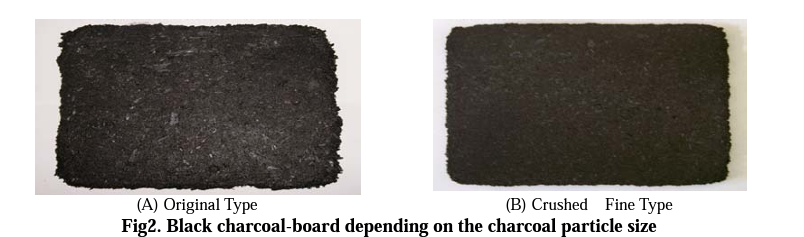
Result: P15%+M5%:MDI(M), poly vinyl acetate(P) emulsion. Fine mixed particle size〔#6-12(16.9%), #12-18(16.7%), #12-40(47.2%), #40-60(9.5%), #60-100(5.9%), smaller than #100(3.8%)〕gives better results than larger particle size〔than #6(33.8%), #12-18(17.7%), #12-40(37.7%), #40-60(6.4%), #60-100(2.6%), less than #100(1.8%) The final moisture content of the carpet is preferably 36%.
Black carbon sheets show less MOR and IB (internal bonding), more WA (water absorption) than white carbon sheets. Black carbon panels not only show the same gas absorption and dimensional stability as white carbon panels, but also have good cutting, nailing and drilling properties for indoor environmental systems.
Keywords: charcoal board, final carpet moisture, charcoal particle size, hot pressing cycle, household wood scrap
INTRODUCTION
Charcoal is a black residue consisting mainly of pure carbon obtained by partial combustion or kiln destruction of organic material. It is usually produced by heating wood in the absence of oxygen. Charcoal has the characteristics of soft, brittle, light, black and spongy. And it is composed of 50% to 95% carbon with the remainder being volatile chemicals and ash. Charcoal, being almost pure carbon, produces a greater amount of heat in proportion to its volume than a corresponding amount of wood; As a fuel, it has the further advantage of being smokeless. In general, coals with higher carbonization temperatures show higher ignition temperatures. When coal has a higher residual volatile chemical content, it has a lower ignition temperature.
Accepted: May 15, 2010
Research: supported by the Technology Development Program of the Ministry of Agriculture and Forestry, Republic of Korea.
School: Agriculture and Life Sciences, Chungnam National University,
Address: Daejeon 305-764, South Korea
Author: Hwa Hyoung Lee
Ncontent: observation after exposing wood to about 600°C with increasing carbonization temperature (wood becomes char). Changes in atomic ratios become stable at temperatures above 600°C.
According to modern methods: wood chips, rotten wood, wood powder, pressed wood, old wooden furniture (recycled wood) are raised to high temperatures in ovens above 600°C to become charcoal to have more value
Charcoal has attracted a lot of attention not only because of its environmental friendliness but also because of its properties. its unique functions, such as moisture absorption catalyst, air conditioning and filtration, deodorization, avoidance of infrared emission and electromagnetic shielding effect.
Charcoal can be activated to increase its effectiveness as a filter. Activated carbon easily absorbs a variety of organic compounds dissolved or suspended in gases and liquids. Charcoal is often used as a filtering material to remove bacteria and unwanted tastes in air or water.
Historically, charcoal has been used in large quantities as an industrial fuel. Charcoal was consumed in the past as a dietary supplement for stomach problems in the form of charcoal crackers.
It can now be consumed in tablet, capsule or powder form to benefit the digestive system. Charcoal absorbs gases and toxins to help cure heartburn, bloating or indigestion.
Indoor air quality can affect the health and comfort of building occupants. More and more people are interested in indoor air filtration because indoor air quality has many pollutants and sick house syndrome.
Furthermore, recent findings have demonstrated that indoor air is often more polluted than outdoor air. To improve indoor air quality, baskets and bins filled with lump charcoal are placed next to televisions and computers, in closets and shoe cabinets.
Recently, non-woven fabric sacks filled with charcoal powder were placed on the floor and living room, and non-woven fabric panels filled with charcoal powder were installed on the wall to eliminate toxic gases and odors.
Especially volatile organic compounds and formaldehyde are regulated in the indoor air environment. Because people today spend most of their time at home or in the office, long-term exposure to organic pollutants (VOCs) in indoor environments can contribute to sick building syndrome.
Many construction materials such as paints, adhesives, wallboards and ceiling tiles release formaldehyde, which can affect mucous membranes and can make a person irritated and uncomfortable. There are also many sources of VOCs in office buildings, including new furniture, wall coverings, and office equipment such as copiers that can release VOCs into the air.
Lee et al (2004, 2005) attempted to utilize the beneficial properties of charcoal to promote a pleasant residential environment through improving indoor air quality.
Lee and colleagues (2006) developed a new method for the rapid production of carbon fiberboard and composite charcoal board with excellent properties such as dimensional safety, gas absorption and far infrared emission for building interior materials.
Park and colleagues (2009) also invented a technique to produce crack-free carbonized boards from fiberboard. Wood-ceramics were developed from wood waste as a new porous carbon material obtained by carbonizing wood materials impregnated with thermosetting resins, such as phenolic resins, in a high-temperature vacuum furnace
Nresearch: see details and post at Korean science
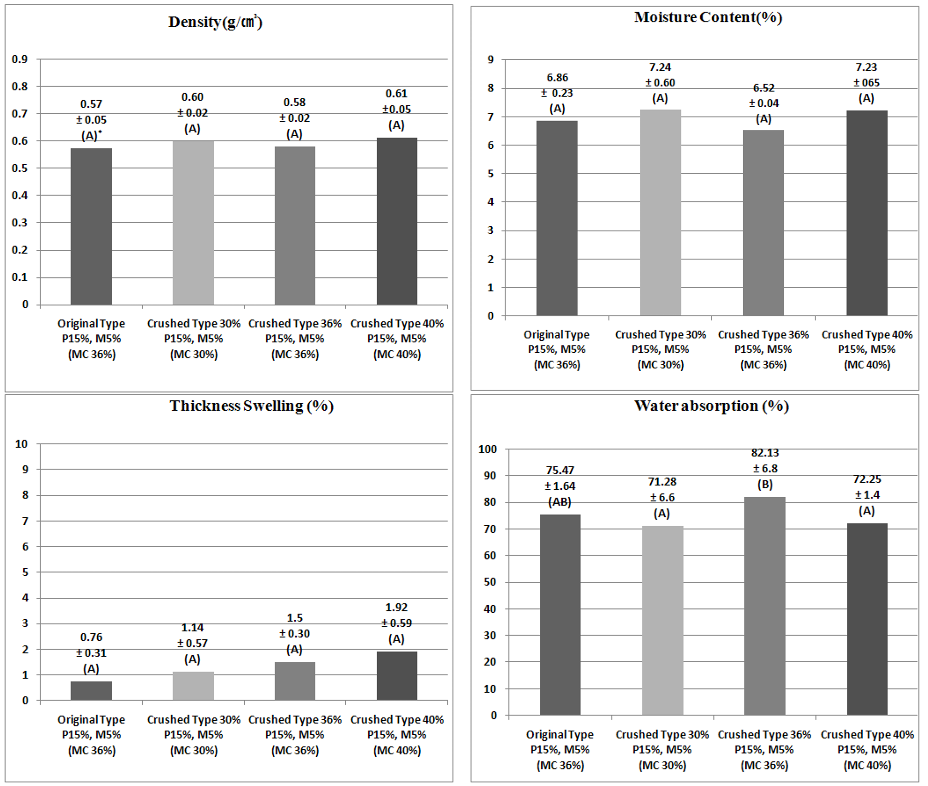
Physical properties of Coal slabs according to particle size and final moisture content of the slab (* Duncan's Multiple Test)
These types of composite wood charcoal panels have been targeted for use as green materials and there are many solutions such as large-scale mass production processes. The application of synthetic charcoal panels for interior design has become a trend of using environmentally friendly materials with the benefits of replacing and beautifying home interiors. Construction and installation using carpentry tools: Sawing, cutting, nailing and drilling are easier for indoor environmental systems.
The purpose of this study is to deeply examine the properties of carbon black boards, characterize the properties of carbon black boards produced from household wood scraps that help with waste treatment problems, and examine the beneficial functional properties of charcoal (carbon material). As a happy building material for indoor environment.
The successful research of recycled wood into charcoal powder is the premise for developing and producing composite carbon panels (carbon + PS plastic), resulting in panel products with outstanding advantages: ultra-light materials + environmentally friendly + eternal + luxurious
The main ingredients of Korean wall panels Wellmark are Carbon charcoal and PS plastic, which have the function of electrical insulation, heat insulation, antibacterial, water-proof, anti-fungal, anti-cracking and deformation, anti-chemical corrosion
Activated carbon also has the function of air filtration and anti-worm. weevil,
The Wellmark panel is manufactured using extrusion technology, so the color, size and shape of the product are uniformly controlled, to truly realize on-demand customization and flexible decoration, minimizing costs and saving forest resources.
Korean cladding panels Wellmark is an ideal replacement for traditional cladding panels, with advantages such as light weight, high resistance to moisture and mold, easy maintenance and quick installation, and waterproof.

Panels Wellmark 10 Advantages & Outstanding Features:
--Light weight, easy to transport
--Highly resistant to moisture and mold
--Easy to maintain, quick and easy installation easy
--Waterproof, anti-moss
--Various patterns and colors
--Vivid and modern design
--Noise and sound absorption
--Electrical insulation, non-thermal conductivity, anti-electromagnetic
--Antibacterial, anti-insect
--Filtering air, dehumidify, and green the environment
Added to the surface is a 3D hot-stamping and embossing impression that is strong, noble and elegant and is light with an aesthetic surface.
Vowing to its advantages and versatility, Korean wall panels Wellmark are widely used in interior decoration such as walls, ceilings, partitions and roofs: hotels, resorts, restaurants, offices, stores, shopping centers, schools schools, hospitals, sports fields, airports and many other places.
Product Wellmark is an ecological synthetic charcoal wood suitable for all environments, including living rooms, bedrooms, offices, tea rooms, libraries, recording studios, music rooms, photography and laboratories.
Wellmark panels are perfectly suitable for wet places such as bathrooms, kitchens, toilets, saunas, yacht decorations, ceilings and roofs
From the structural composition and surface pattern design, the Wellmark panel becomes a decorative material that completes from the inside out the elegant appearance, worthy of making the houses as happy as the name Wellmark: Brand & Manh Khoe